


What are the advantages of customized aluminum profile racks?
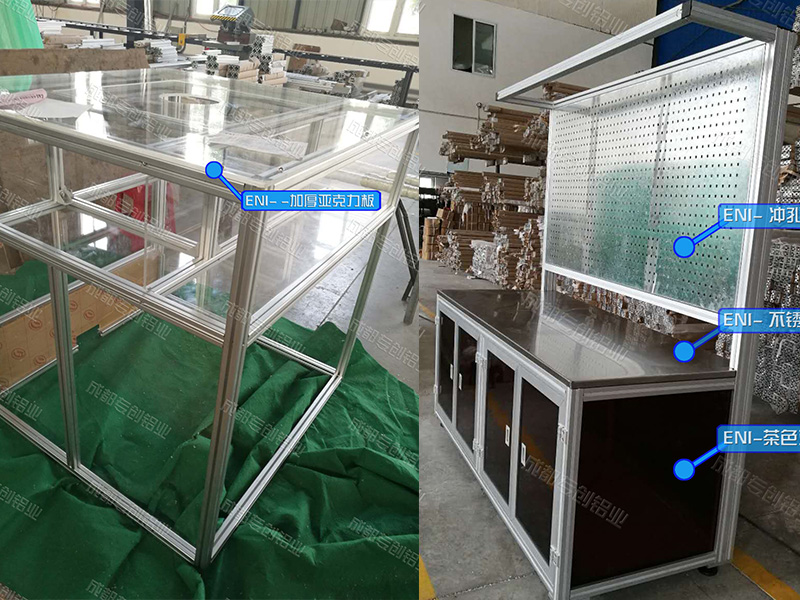
The core advantage of the customized aluminum profile frame product is that it allows the “model selection – processing – assembly” process to be completed by a single source factory. Customers receive a frame that can be installed directly, rather than a pile of loose profile pieces that require cutting and drilling by themselves.
In practical projects, the finished product delivery method demonstrates four benefits: dimensions and hole positions are processed according to the drawings, eliminating the need for secondary modification on site; accessories and profiles are sourced and matched from the same origin, eliminating the possibility of mismatched specifications; disassembly and assembly are convenient, allowing for dismantling, modification, and reuse during production line adjustments; pre-assembly inspection is completed before the finished product leaves the factory, exposing assembly risks in advance. For scenarios requiring frequent iteration, such as automated equipment, testing equipment, and production line stations, finished product delivery saves more manpower and time compared to purchasing profiles directly.
Why choose aluminum profiles as the raw material for machine frames? Let’s look at three material characteristics
The choice of aluminum profiles as processing materials primarily relies on three characteristics they exhibit during long-term use.
1. Long service life
Aluminum profiles are connected with bolts and corner fittings, without welding, ensuring no damage to the material during disassembly and assembly. When adjusting or relocating the production line, the frame can be disassembled as a whole and reassembled, achieving a high rate of material reuse.
2. Anti-oxidation
Aluminum naturally forms a dense oxide film in the air, and its surface becomes more stable after anodizing or electrophoresis treatment. It is less prone to rusting and white spots in workshops with high humidity.
3. Wear resistance
Industrial aluminum profiles, after undergoing aging treatment, exhibit superior surface hardness and structural stability. The wear caused by daily handling, wiping, and equipment vibration is relatively manageable. When used in conjunction with locknuts, the joints are less prone to loosening.
These three characteristics determine the long-term cost of using the frame and explain why customized aluminum frames are widely adopted in the automation equipment industry.
What factors should be considered when selecting a manufacturer for custom aluminum profile frame processing?
Whether it’s bulk purchasing (wholesale of aluminum profiles) or small-batch custom processing (retail processing), the logic for evaluating manufacturers is consistent, focusing on the following six items:
- 1. Is it a source factory? We have our own factory and processing equipment, with transparent price structure, controllable delivery time, and fewer intermediate links.
- 2. Processing experience and years of operation: Manufacturers with a longer history and a larger customer base tend to have more mature solutions when dealing with non-standard drawings and complex structures. Over 15 years of processing experience usually indicates a more comprehensive process accumulation.
- 3. Raw material and surface treatment capabilities: Capable of specifying the alloy grade of the profile and the surface treatment method (anodizing, electrophoresis, spray coating), and providing antioxidant solutions for high humidity, clean, and other environments.
- 4. Spot stock of profiles and aluminum profile accessories: Common specifications are available in stock, and accessories such as corner pieces, nuts, and cover strips are sourced and matched to reduce waiting time and ensure timely delivery in batches.
- 5. Processing accuracy and quality control: Whether the flatness of the cutting end face, hole position accuracy, and tapping quality are stable, whether there is capability for CNC cutting, drilling, tapping, and CNC machining, as well as the control process from raw materials to finished products.
- 6. Logistics and delivery cycle: Whether there is a stable logistics plan and whether it is possible to deliver in batches according to the project schedule directly affects the on-site installation plan.
Among these six items, the first five determine the quality of the customized aluminum profile frame itself, while the sixth determines whether the project can proceed as planned.
Frequently Asked Questions (FAQ)
How long is the service life of the customized aluminum profile frame?
In a conventional workshop environment, industrial aluminum profiles that have undergone standardized surface treatment exhibit more stable oxidation resistance and wear resistance, resulting in a longer service life. The frames are connected using bolts, ensuring that disassembly and assembly do not damage the material. After production line modification, they can be reused or recycled.
What is the difference between wholesale and retail processing of aluminum profiles?
Wholesale purchases are made in whole units or tons, suitable for customers with stable demand; retail processing is customized according to individual drawings, suitable for small batches and non-standard scenarios. A source factory capable of undertaking both modes can save time and effort when combined.
How is the delivery cycle of customized racks controlled?
Common specifications are available in stock, and with manufacturers that own the processing procedures, the delivery schedule is more controllable, and the logistics process is simpler. It is recommended to confirm the availability of profile materials, accessory compatibility, and delivery arrangements during the inquiry stage.
Action: Prepare these three things before inquiring about prices
- 1. Organize drawings or size lists, indicating profile specifications, load-bearing requirements, and installation methods;
- 2. Specify the usage environment (humidity, cleanliness, whether it comes into contact with cutting fluid) to facilitate the manufacturer’s matching of surface treatment solutions;
- 3. Confirm the source of goods and logistics arrangements, and request the supplier to provide a list of available specifications and a delivery plan.
Post time: Sep-28-2026