


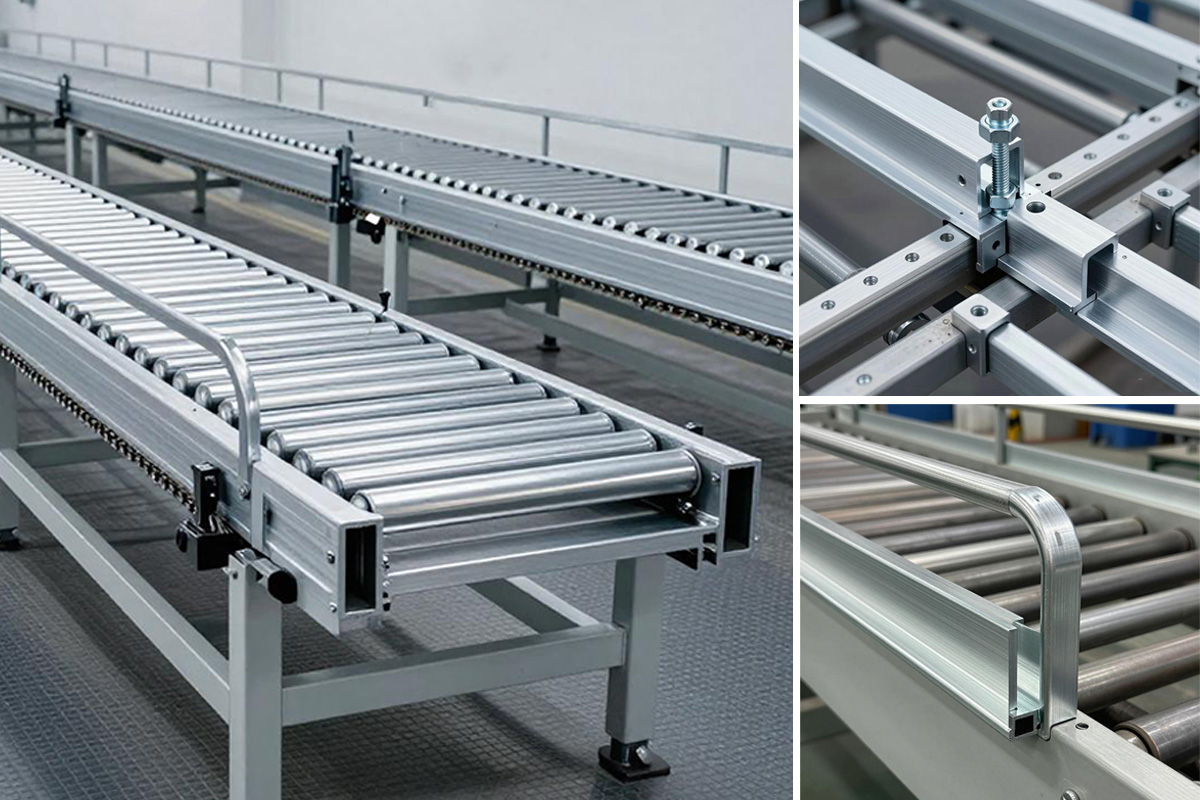
Industrial aluminum profiles are used as the core base material of the entire machine frame. The overall structure is composed of bottom fixed support brackets, high-precision roller modules, safety side guardrails, silent transmission chains and other components. The roller part can be flexibly selected according to the actual transportation scenario: food-grade stainless steel pipes are suitable for clean production scenarios, high-strength galvanized pipes meet regular heavy-load requirements, and anti-skid rubber-coated pipes can effectively avoid offset and slipping during the transportation of light materials. Under electric drive, they can smoothly complete the continuous transmission of various materials in different scenarios such as production workshops, packaging workshops, and warehousing and sorting areas.
In terms of frame selection, we will provide precise adaptation solutions based on actual working conditions:
for conventional light-load transportation scenarios, 4040 or 4080 series industrial aluminum profiles are preferred to build the frame, taking into account portability and structural strength; for heavy workpiece transportation scenarios, it can be upgraded to 60 series or even 80 series aluminum profiles as the main support frame, which can easily carry long-term high-frequency transportation of heavy-weight materials. Taking into account the continuous high-frequency vibration generated during the operation of the transmission line, the bottoms of all columns are equipped with special feet for fastening and fixation as standard. Special conveyor sections that require height adjustment can also be replaced with adjustable feet. All foot connections are completed with standard bolts and nuts, making subsequent daily maintenance and component replacement very convenient.
For the special structural parts of the assembly line, the customized advantages of aluminum profiles can also be fully utilized:
the turning section of the conveyor line can be directly formed into one piece using the aluminum profile bending process, without the need for additional splicing accessories; the protective section on the edge of the drum is formed using special aluminum angle bending, which can not only avoid jamming during material transportation, but also prevent operators from accidentally bumping into each other. All aluminum profiles used under normal working conditions have undergone high-standard anodizing treatment, and their surfaces are wear-resistant and scratch-resistant. They can maintain stable appearance and performance even in long-term operation in ordinary production environments. For special scenarios such as fresh food processing and chemical production where the environment is humid and corrosive, the surface treatment process can also be upgraded according to needs: powder spraying and electrophoresis processes are used to further improve corrosion resistance. For heavily polluted and highly corrosive chemical scenarios, the fluorocarbon spraying process can be used to greatly extend the overall service life of the equipment.
In terms of the frame connection process, regular parts adopt an embedded connection method of drilling and tapping, making the whole machine look neat and smooth.
For key workstations with high load-bearing and high losses, additional high-strength corner pieces will be installed for reinforcement. All corner pieces are also locked with standard bolts and nuts, which not only ensures the ultra-high load-bearing performance of the overall structure, but also makes subsequent disassembly, adjustment, and relocation simple and efficient.
Post time: Jul-01-2026